A Place Name, Read with Care
A place name, read with care, can suggest language and landscape while showing which historical claims still need support from independent evidence.
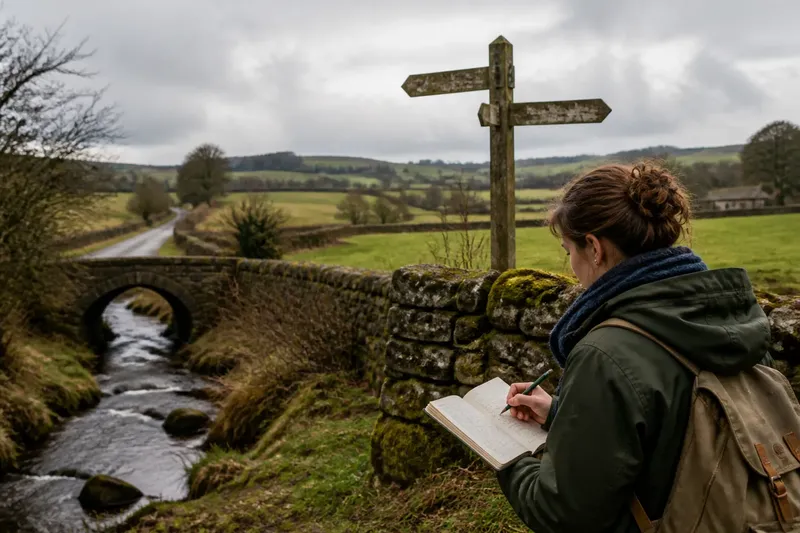
You pass a sign for Millbrook on the way to a village shop, and the name seems to offer a small history lesson. Reading a place name with care means treating that impression as a clue, not as proof: a mill and a brook may fit the words, but the name alone cannot show what stood there.
A name may preserve an older word, describe a feature, refer to a person or reflect sounds that have changed. It may also have been altered or transferred by speakers of another language. The useful question is not only what a name might mean, but what its form can support and what needs separate evidence.
Start with the name
Write the name exactly as it appears on a current map or sign, keeping its spelling and spacing. If local forms exist in Welsh, Gaelic or another language, record each separately rather than merging them into one interpretation.
Note what kind of place the name identifies. A town, hill, farm, stream and neighbourhood can share a name while referring to different features. A settlement name may have been transferred from a stream nearby; that does not mean both names began at the same time.
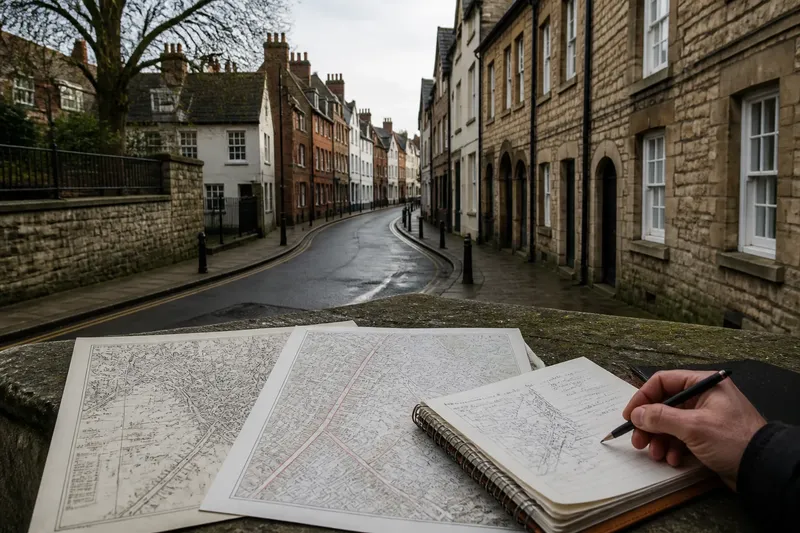
Mark the location on an Ordnance Survey map, a local authority map or another reliable map. Record visible features that may be relevant, such as a stream, wooded slope, ridge or former industrial site. These observations describe the present setting, not necessarily the landscape when the name arose.
For an initial reading, divide the written form into plausible parts without deciding what they mean. In Millbrook, “mill” and “brook” look like recognisable English elements. That is an observation, not evidence of a mill’s location, date or owners.
Compare recorded forms
Spelling changes as names pass through documents, maps, speech and administrative practice. A modern form may preserve an older element, obscure it or reflect a later spelling choice. Check a place-name dictionary or specialist gazetteer for the exact name and possible earlier forms. The Survey of English Place-Names and the Oxford Dictionary of British Place Names are examples for English names; other regions have their own resources.
When a source lists earlier forms, record where and when each was written down, if that information is given. A form copied from a later map is not necessarily an independent early witness. A spelling that resembles a familiar word may also be a later reinterpretation.
Keep a simple record of the form, its source and the source’s proposed explanation. If sources disagree, preserve the disagreement instead of choosing the neatest story.
- Check the current spelling and place type; if the map and sign differ, record both and identify where each form appears.
- Check whether an earlier form has a named source; if its source is unclear, mark it as unverified rather than treating it as evidence.
- Check the date and location attached to each recorded form; if either is missing, note that limitation before comparing spellings.
- Check whether two sources rely on separate records; if one appears to copy the other, treat them as one line of evidence.
- Check whether a proposed meaning is attributed to a specialist source; if not, present it as a possibility to investigate, not an established interpretation.
- Check for competing linguistic explanations; if they remain plausible, report the disagreement and explain which evidence supports each.
Test possible elements
Place names often contain elements that once had meanings in a local language. They may describe a natural feature, a settlement, a person or a use of land. Sound and spelling can offer a lead, but resemblance alone is weak evidence: similar sounds can arise by chance, and word meanings change.
Check whether a proposed element belongs to the relevant language and fits the name’s recorded forms. A specialist dictionary or place-name authority can help distinguish a linguistic analysis from a guess based on modern English. Grammar matters too; speakers may have changed a name’s order, endings or pronunciation.
Ask whether the suggested meaning suits the kind of feature named. A water-related element may be plausible in a stream name, but names can move from one feature to another. A good fit makes an interpretation worth considering; it does not settle the question.
Say you are examining a fictional place called Stonefield, shown on a present-day map beside open farmland. You find an older recorded form and a reference source proposing one element meaning “stone” and another associated with open land. You can report that the analysis is plausible and that the current setting is compatible with it. You cannot infer from the name alone that a particular stone stood there, that the fields are ancient or that the settlement began when the name was first recorded.
Separate clue from claim
Sort the evidence into three levels. Direct observation includes the current spelling, map location and documented earlier forms. Linguistic interpretation is what a specialist source says the elements may mean. Historical claims concern who lived there, what they did or when a feature was built.
The first two levels may inform the third, but they do not establish it automatically. A name containing a word associated with a person does not identify that person without supporting records. A name that seems to refer to a religious feature does not prove that a particular building stood there.
For a historical claim, seek evidence suited to it: maps from different periods, documents about land or settlement, archaeological records or local archives. Each source has limits. A map may omit small features, while a document may use a spelling that is difficult to identify. Compare these materials as separate evidence rather than as decoration for a story already decided by the name.
Take particular care with names that seem to identify a group, occupation or event. A name may have been transferred from elsewhere, attached later or reshaped by unfamiliar speakers. Without corroboration, say that it “may preserve” a clue or “has been interpreted as” something rather than stating local history as fact.
What remains uncertain?
Can a place name date a settlement?
Usually, a name alone cannot establish when a settlement began. An early recorded form shows that the name was in use by the time it was written down, but the settlement may be older or the name may have been applied later.
Does a matching landscape feature confirm the meaning?
A stream, hill or woodland that fits a proposed meaning makes the interpretation worth considering. The feature may have changed, vanished or acquired the name after another name was already in use, so the match is not proof.
Can spelling reveal the original language?
Spelling can offer clues, especially when earlier forms survive, but a modern form may reflect several languages and writing habits. A specialist source can assess language and sound changes more reliably than a resemblance to a familiar word.
What should you do when sources disagree?
State that more than one interpretation exists and identify the source for each. If one has stronger linguistic or documentary support, explain why while keeping any remaining uncertainty visible.
Write a bounded account
A careful interpretation can still be vivid. Give the reader the present form, the place it identifies, useful earlier forms and the best-supported linguistic proposal. Then state what that proposal does not establish.
Choose verbs that match the evidence. “The name contains an element interpreted as…” signals a sourced linguistic reading. “The name may refer to…” leaves room for uncertainty. “The name proves…” is rarely justified by the name alone. Attribute a firm analysis to its reference source instead of expanding it into claims the source does not make.
For instance, a concise account might say that a place name is recorded in an earlier form and is commonly analysed as containing an element associated with water. A nearby stream may make that reading plausible, but the name does not establish when the settlement began or how its original boundaries were drawn.
Reading a place name with care means keeping the spelling, source and conclusion connected. A name can preserve a linguistic trace and point towards useful questions about landscape or settlement. Its strongest contribution may be to show which records to seek next, while leaving the history open until those records support it.